Definition
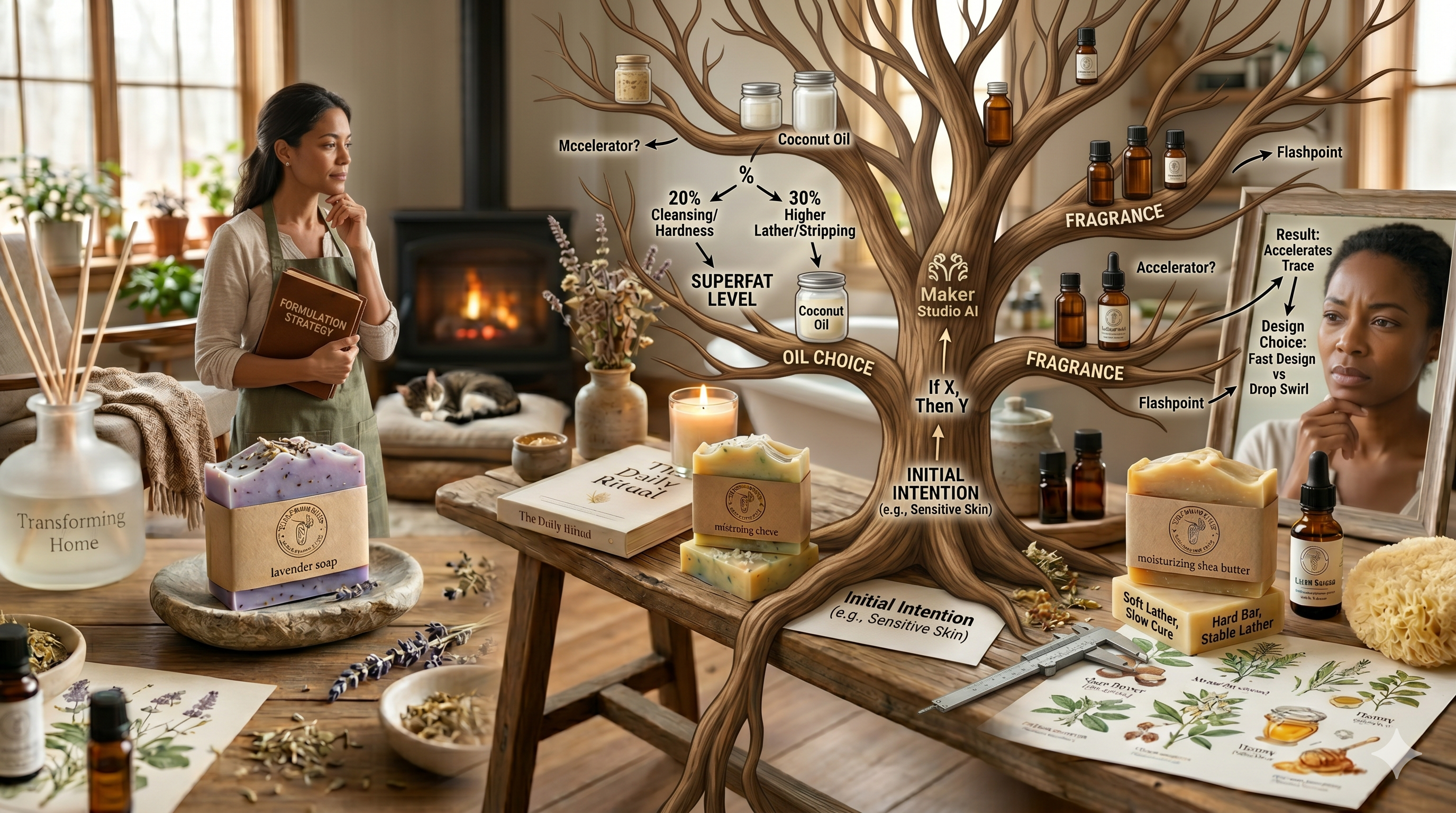
At its core, every formula you create, whether for soap, lotion, or any handmade product, is not just a list of ingredients but a complex decision tree. Each component, from the type of oil to its percentage, the superfat level, the fragrance choice, and even the curing method, represents a branch in this tree. Your initial choices lead to subsequent decisions, and each decision carries a specific outcome, influencing the final product's texture, lather, stability, and overall performance. Understanding this framework means recognizing that your formula isn't static; it's a dynamic system of interconnected choices.
This perspective shifts the focus from merely following a recipe to actively engaging with the why behind each ingredient and process step. It encourages you to think critically about the properties each component brings to the table and how they interact. For instance, choosing coconut oil at 30% versus 20% isn't just a number change; it's a decision that impacts hardness, cleansing, and lather, setting off a cascade of other considerations for balancing the formula. This decision-tree approach empowers you to predict outcomes and intentionally design products rather than just assembling them.
Why It Matters
Embracing the 'decision tree' mindset fundamentally transforms how a maker approaches product development and problem-solving. Instead of feeling overwhelmed by a failed batch or an unexpected result, you gain a systematic way to trace back through your choices. It moves you from a reactive stance—wondering 'what went wrong?'—to a proactive one, asking 'which decision led to this outcome, and what alternative decision could I make next time?' This analytical framework builds confidence, allowing you to iterate and innovate with purpose.
Furthermore, this understanding is crucial for scaling and consistency. When you know why a formula works, you can adapt it for different ingredient suppliers, adjust for seasonal variations, or modify it to create new product lines without starting from scratch. It's the difference between being a recipe follower and becoming a true formulator, capable of creating unique, high-quality products that consistently meet your standards and your customers' expectations. This strategic thinking elevates your craft from a hobby to a sophisticated, controlled process.
What It Solves
The 'Every Formula Is a Decision Tree' concept directly addresses several common frustrations and blind spots for handmade product entrepreneurs. Firstly, it tackles the pervasive issue of troubleshooting failures. When a batch doesn't turn out as expected, makers often feel lost, unable to pinpoint the cause. By viewing the formula as a decision tree, you can systematically review each choice made—from ingredient selection to processing temperature—to identify the exact point where the desired outcome diverged, making problem resolution far more efficient and less frustrating.
Secondly, it overcomes the limitation of being overly reliant on existing recipes. Many makers struggle to create original formulations or adapt recipes to their specific needs or available ingredients. This framework provides the mental model to confidently experiment, understanding that each modification is a deliberate branch in the decision tree, rather than a random alteration. It also resolves the challenge of inconsistent product quality, as understanding the decision points allows for greater control and replication of successful outcomes, leading to a more reliable and professional product line.
Where It Shows Up
This concept manifests in countless real-world scenarios within a maker's daily work. In the studio, it appears when you're selecting a new oil for a soap recipe, weighing its fatty acid profile against your desired bar characteristics, or deciding on a superfat percentage based on skin feel and cure time. Every measurement, every temperature check, and every pour is a decision with a direct impact on the final product. It's evident when you're adjusting a fragrance oil percentage, considering its flashpoint and how it might accelerate trace, or when you're choosing between a water discount or a full water amount for a specific design.
In the spreadsheet, the decision tree is at play when you're calculating lye amounts for a new oil blend, where each oil's saponification value influences the overall lye requirement, or when you're using the Cost Tracker to evaluate how swapping a premium butter for a more economical oil impacts your profit margins. Even in conversations with customers, this framework is invaluable. When a customer asks for a custom product or inquires about ingredient substitutions due to allergies, you can confidently explain the implications of those choices, demonstrating your expertise and the intentionality behind your formulations.
When I first started making soap, I was a recipe follower, pure and simple. I'd find a formula, gather the ingredients, and hope for the best. But then a batch would seize, or the lather wasn't quite right, and I'd be completely stumped. I remember one particularly frustrating batch where I tried to substitute an oil without understanding its properties, and the soap turned into a crumbly mess. It was a costly mistake, not just in ingredients, but in time and confidence. That's when I realized I needed to move beyond just 'doing' and start 'understanding.'
I began to see each ingredient as a player in a team, each with a specific role, and my formula as the strategy. This shift, from recipe to decision tree, was a game-changer. It allowed me to troubleshoot with precision, adapt my formulas for different climates, and eventually, create my own unique recipes with confidence. It’s a hard-won lesson that transformed my approach to formulation, turning frustrations into learning opportunities and enabling me to truly master my craft.
Apply this in Maker Studio AI
Maker Studio AI connects your recipes, batches, inventory, shows, sales, and marketing — built for handmade product makers.
Explore Paid Plans →