Create Your Best Soap Recipe Ever: Mastering Soap Calculators
Imagine you're in your kitchen, surrounded by oils and butters, ready to create your first batch of homemade soap. You've got a recipe you pulled off the internet, but what type of bar can you actually expect? Is it going to be cleansing? Perhaps you've tried to use a soap calculator only to be confused by all the numbers it throws back at you.
Soon enough, that excitement turns into a confusing chemistry class when you realize creating a soap recipe isn't just about throwing ingredients together. Fear not — if 70% of new soap makers feel overwhelmed by the process, you're definitely not alone.
Understanding the Essentials of a Soap Recipe
The Backbone of a Soap Recipe: Fatty Acids
It all starts with fatty acids. Every oil and butter you use to make soap is made up of fatty acids, and these building blocks determine the properties of your finished bar. Lauric acid makes your soap hard and cleansing, while oleic acid provides conditioning benefits. Understanding what each fatty acid contributes allows you to balance your recipe with intention rather than guesswork.
This is exactly why soap calculators exist — and why knowing how to read one is one of the most valuable skills you can develop as a soap maker.
Balancing Your Recipe with a Soap Calculator
Creating the right soap recipe is like cooking a gourmet meal: you need the right blend of ingredients in the right proportions. A soap calculator shows you the fatty acid profile of your chosen oils and butters, letting you tweak your recipe until it hits the right balance before you ever mix a single batch.
If you're like many beginners, you're probably starting with a recipe you found online. Running it through a soap calculator first lets you analyze the quality of that recipe before you commit to making it — saving you time, money, and frustration.
Two tools worth knowing:
- SoapCalc.net — the classic free web-based calculator. Great for learning the fundamentals of fatty acid math and understanding lye calculations.
- Maker Studio AI's Soap Calculator — a free calculator built specifically for handmade soap makers who want to go beyond the math. It connects your recipe directly to your batch records, cost tracking, and production history so your formulas are never lost in a notebook.
Try it free: The Maker Studio AI soap calculator is available at makerstudio.livesoapschool.com/calculator — no account required to get started.
How to Use a Soap Calculator
Whether you're using SoapCalc or Maker Studio AI, the core workflow is the same. Here's a simple guide to using one effectively:
- Know the Size of Your Batch — Start by deciding how much soap you want to make. This tells the calculator the right proportions for your ingredients.
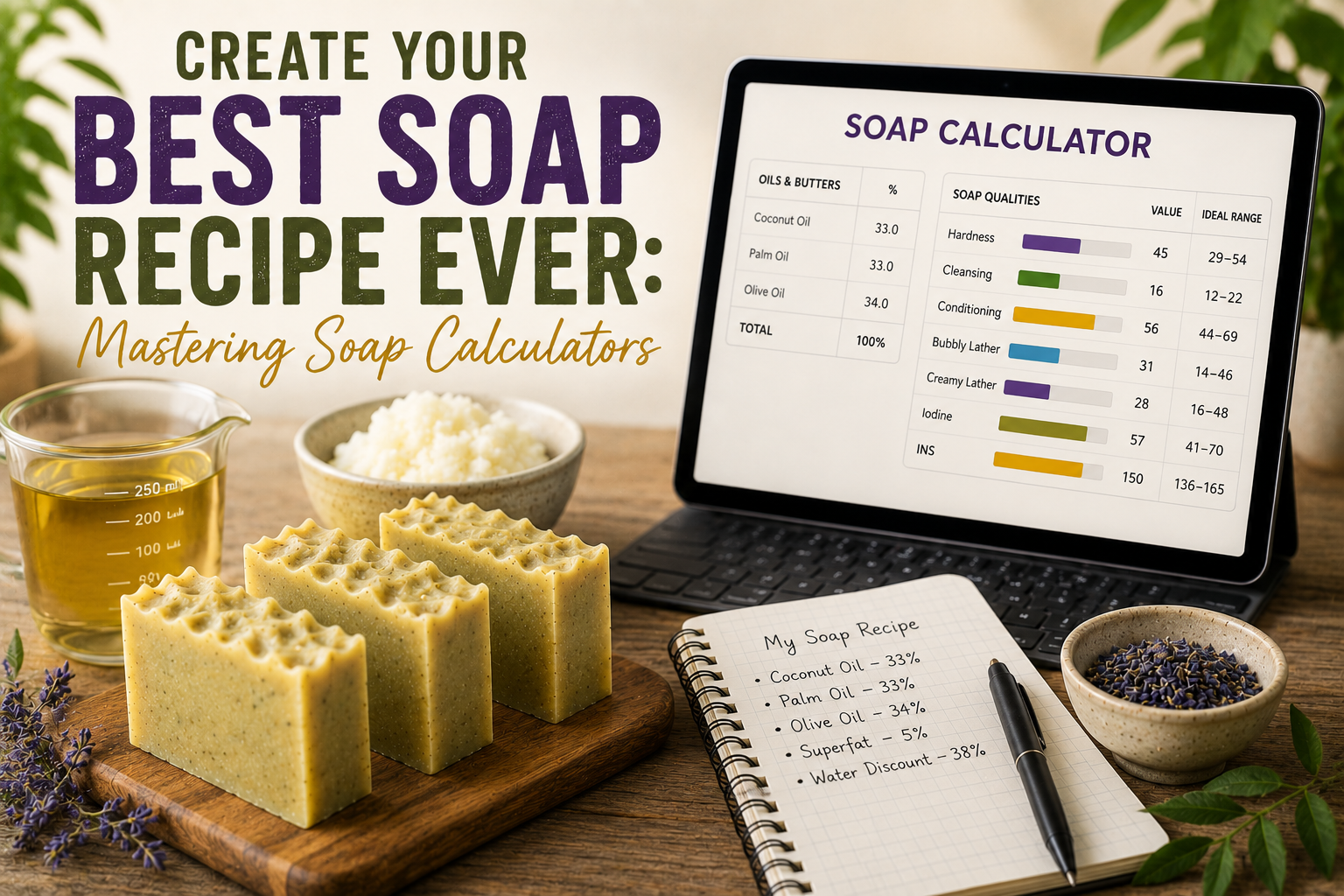
- Input Your Oils and Butters — Add each ingredient and its percentage. Your ingredients must total 100% of your oil weight. A classic starting point — often called the "holy trinity" — is 33% coconut oil, 33% palm oil, and 34% olive oil. This blend offers a solid balance of hardness, lather, and conditioning.
- Analyze the Soap Qualities — Look at the numbers for hardness, cleansing, conditioning, bubbly lather, and creamy lather, as well as iodine and INS values. The calculator provides recommended ranges to aim for. Adjust your oil percentages until the numbers fall within those ranges.
- Adjust Superfat and Water — Your superfat percentage controls how many unsaponified oils remain in the finished bar for moisturizing. Your water-to-lye ratio affects cure time and bar hardness. Both significantly impact the final feel of your soap.
What Do the Numbers Mean?
| Quality | What It Measures | Ideal Range |
|---|---|---|
| Hardness | How firm and long-lasting the bar will be | 29–54 |
| Cleansing | Ability to remove dirt and oil | 12–22 |
| Conditioning | Moisturizing and skin-nourishing properties | 44–69 |
| Bubbly Lather | Large, airy bubbles | 14–46 |
| Creamy Lather | Small, dense, stable bubbles | 16–48 |
| Iodine | Unsaturation of oils; lower = harder bar | 41–70 |
| INS | Combined hardness predictor | 136–165 |
High cleansing values can be drying if not balanced with conditioning oils — this is the most common mistake beginners make when they reach for a coconut-oil-heavy recipe.
Tips for Experimenting and Perfecting Your Recipes
Creating your signature soap involves some trial and error. Here are the habits that separate soap makers who improve quickly from those who keep repeating the same mistakes:
- Start Simple — Begin with three to five oils and get familiar with their individual properties before introducing more complex blends.
- Experiment Gradually — Adjust oil percentages incrementally and observe how each change impacts the finished bar. Small changes lead to significant differences.
- Document Everything — Write down your recipes, including oil percentages, superfat, water amount, and any additives. Note what worked, what didn't, and how the soap performed. This documentation is invaluable for refining your formulas over time.
- Understand SAP Values — Each oil has a Saponification Value (SAP), which is the amount of lye needed to convert that oil into soap. Soap calculators handle this math automatically, but understanding it helps you appreciate why the numbers matter.
- Consider Additives Last — Once you're comfortable with your base recipe, explore clays, botanicals, or exfoliants. Remember to account for any oil content they introduce.
From Calculator to Batch Record
One of the biggest gaps in most soap makers' workflows is what happens after the calculator. You formulate a great recipe, make the batch, and then... where does that recipe live? A notebook? A spreadsheet? A photo on your phone?
This is where Maker Studio AI was built to help. When you save a recipe in Maker Studio, it stays connected to every batch you make from it — including your notes, photos, cure dates, and cost per bar. When you're ready to scale up or submit to a craft show, your full production history is right there.
Ready to level up your recipe workflow? Start your free Maker Studio AI account and bring your soap calculator, batch records, and business tools into one place.
The Art and Science of Soap Making
Soap making is part art, part science. You don't need to be an expert chemist, but understanding fatty acids and how to read a soap calculator will take you a very long way toward crafting bars that are truly your own.

The joy comes from the learning process — each batch, whether it turns out perfectly or teaches you something unexpected, builds your skills. By mastering the use of soap calculators and understanding the role of fatty acids, you'll make the kind of soap that not only meets your own standards but exceeds the expectations of your customers.
Still need help? Join us in Live Soap School to take an Introduction to Soap Making class, completely online — and bring your Maker Studio AI account with you to track every batch from day one.
Until next time,
Zakia
Manage your soap business in one place
Maker Studio AI connects your recipes, batches, inventory, shows, sales, and marketing — built for handmade product makers.
Explore Paid Plans →